It began with the sickening crack of carbon fiber against unforgiving asphalt. On a descent in the 2024 Tour of the Basque Country, the cycling world held its breath as Jonas Vingegaard, the reigning two-time Tour de France champion, lay motionless in a concrete ditch, his season—and perhaps his career—shattered alongside his clavicle and ribs. It was a moment of profound fragility for a rider who had seemed invincible, the quiet king of the mountains brought low by a cruel twist of fate. The yellow and black jersey of Team Visma | Lease a Bike, a symbol of dominance, was suddenly a shroud of uncertainty.
Yet, from the sterile confines of an intensive care unit to the sun-scorched roads of France, a story of incredible resilience began to unfold. The team itself dubbed it “A TRUE RENAISSANCE”. In a feat of superhuman determination, Vingegaard returned to the 2024 Tour de France, a shadow of his former self physically, but with a spirit forged in the crucible of his recovery. “If you had told me three months ago after the crash that I would be able to finish second in the Tour, I wouldn’t have believed it myself,” Vingegaard admitted, his words underscoring the sheer improbability of his comeback. While he ultimately conceded the maillot jaune to his great rival, Tadej Pogačar, his presence on the podium in Nice was a victory of a different, more profound kind.
That comeback, however, was not the end of the story; it was the prologue. For the 2025 Tour de France, Team Visma | Lease a Bike has responded not with caution, but with overwhelming force. They have assembled what is, on paper, one of the most powerful and versatile Grand Tour squads in modern history. It is an armada built for a singular purpose: to reclaim the throne. Alongside Vingegaard stand Wout van Aert, the all-powerful “Swiss army knife”; Matteo Jorgenson, the ascendant American star; Simon Yates, fresh off a cathartic Giro d’Italia victory; and a legion of specialists including Sepp Kuss, Tiesj Benoot, Victor Campenaerts, and Edoardo Affini. This is Visma’s ultimate strategic answer to the Pogačar problem. But as the peloton prepares to roll out of Lille, the central question hangs heavy in the summer air: Is this collection of individual brilliance and collective might enough to dethrone a king who has redefined the limits of the sport?
Lineup
1. Jonas Vingegaard: Pogačar’s arch-nemesis
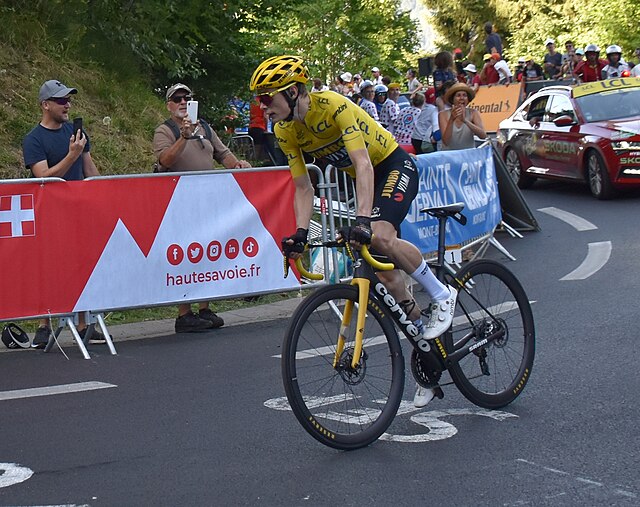
Credit: Jonas Vingegaard @René Hourdry Creative Commons Attribution-Share Alike 4.0
At the heart of the Visma machine is Jonas Vingegaard, the unassuming figure from the fish factories of Hillerslev, Denmark, who transformed into a two-time Tour de France champion. His riding style is a reflection of his personality: quiet, economical, and ruthlessly efficient. He doesn’t possess the explosive punch of his rivals, but his genius lies in his ability to sustain an otherworldly tempo in the high mountains, slowly and methodically suffocating the opposition.
His 2025 season has been a microcosm of his career—a mix of quiet dominance and unnerving setbacks. An early overall victory at the Volta ao Algarve signaled that his recovery from the 2024 trauma was complete. However, a subsequent abandonment at Paris-Nice served as a stark reminder of his fragility, raising questions about his consistency in the face of a full season’s racing load. The most critical test came at the Critérium du Dauphiné, the traditional Tour warm-up. There, he went head-to-head with Pogačar and finished a strong second. This performance confirmed he is back at a world-class level, but it also provided a crucial piece of intelligence: in a straight duel, Pogačar may currently hold a marginal advantage.
This realization has forced a fundamental shift in Visma’s strategic thinking. In their victorious 2022 and 2023 campaigns, they could operate under the assumption that Vingegaard was, at worst, Pogačar’s equal in the mountains. The results of the 2024 Tour and the 2025 Dauphiné challenge that premise. The team’s management, in assembling this 2025 squad, has implicitly acknowledged that they can no longer rely on a simple strategy of their leader dropping the other on the final climb. They need to win the race tactically, creating scenarios where Vingegaard’s endurance and the team’s depth can overcome Pogačar’s individual brilliance. Vingegaard’s greatest weapon, therefore, may no longer be just his legs, but the mental fortitude he forged in 2024. He has faced the abyss and returned, making him an incredibly difficult opponent to break psychologically over the grueling three weeks of the Tour.
2. Wout van Aert: The Swiss Army Knife
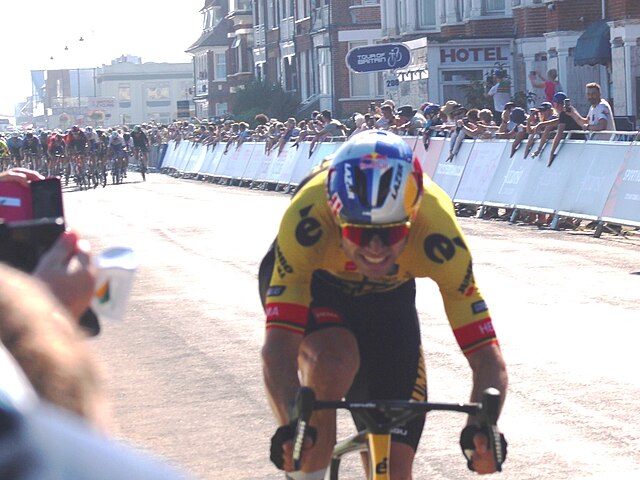
Credit: Wout van Aert @Geof Sheppard Creative Commons Attribution-Share Alike 4.0
There is Wout van Aert, and then there is everyone else. The Belgian is not merely a cyclist; he is a cycling phenomenon, a rider capable of winning bunch sprints, time trials, and mountain stages, often in the same race. In 2025, he is Visma’s ultimate all-terrain weapon. His role is multifaceted: he will hunt for his own stage wins, pilot Vingegaard through the treacherous, windswept flat stages of the first week, and, most critically, serve as a “satellite rider” in the high mountains.
Like his leader, Van Aert has stared down his own injury nightmare, battling back from a horrific crash in 2024 that derailed his spring classics campaign. His performance at the 2025 Giro d’Italia was a masterclass in resilience and a perfect preview of his Tour duties. He claimed a stunning victory on the gravel roads of Stage 9, proving his individual class is as sharp as ever. But it was his performance on Stage 20 that had every rival team taking notes. After spending the day in the breakaway, he waited for his then-leader, Simon Yates, and delivered a monstrous, race-winning pull in the valley that secured the maglia rosa for his teammate. It was a live-fire demonstration of the satellite tactic, proving he can sacrifice his own chances for the team’s greater goal. This loyalty is reinforced by a career-long contract with the team, a pact of “freedom-for-loyalty” that ensures his commitment is absolute when the call comes.
3. Matteo Jorgenson: The American Ascendancy

Credit: Matteo Jorgenson @Martino Photos Creative Commons Attribution-Share Alike 2.0
The rise of Matteo Jorgenson has been nothing short of meteoric. The American from Idaho has evolved from a promising talent into a bona fide star and is designated as Vingegaard’s most important mountain lieutenant and the team’s “second captain”. He is Plan B. His breakthrough came in the 2024 Tour, where he finished an impressive 8th overall while dedicating himself to Vingegaard’s cause.
His 2025 season, however, saw him take a massive leap forward. At Paris-Nice, after Vingegaard was forced to withdraw, Jorgenson stepped seamlessly into the leadership role. With tactical brilliance and immense strength, he seized the overall victory, becoming the first American in 18 years to win the prestigious “Race to the Sun”. This victory was not a fluke; it was the announcement of a new GC contender on the world stage. His presence provides Visma with a formidable second prong of attack. If rival teams focus too heavily on Vingegaard, Jorgenson has the credibility and the power to launch a race-winning move of his own, creating a tactical nightmare for the opposition.
4. Simon Yates: The Pink Avenger
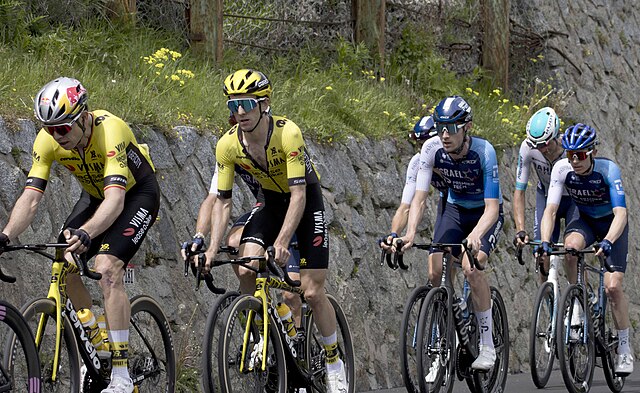
Credit: Simon Yates @filip bossuyt Creative Commons Attribution 2.0
When the road tilts skyward, Visma will unleash a formidable trio of climbers. Headlining this group is Simon Yates, whose inclusion represents the team’s biggest and most fascinating gamble. He arrives at the Tour fresh from a career-defining victory at the Giro d’Italia, where he exorcised the ghosts of his infamous 2018 collapse on the Colle delle Finestre with a spectacular, redemption-fueled ride on the very same climb. The emotional and psychological momentum from that victory is immense, and his decision to move to Visma has been validated in the most spectacular fashion. The risk, however, is the
colossal physical toll of targeting two Grand Tours in a single season. If he has recovered, he is a world-class weapon; if not, he could be a passenger.
5. Sepp Kuss: The Loyal Deputy
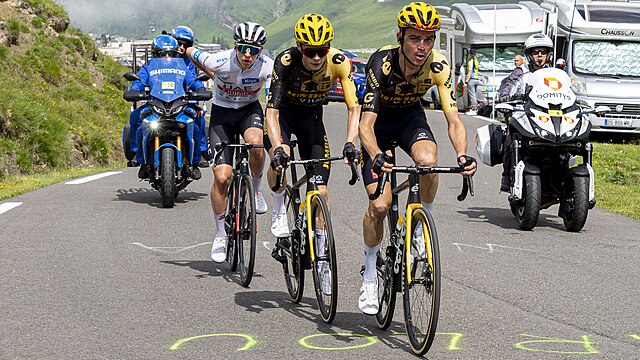
Credit: Sepp Kuss @Shougissime Creative Commons Attribution-Share Alike 4.0
Alongside him is Sepp Kuss, the “Eagle of Durango,” who returns to his preferred role as a “super-domestique”. After the immense pressure of his own Vuelta victory in 2023 and a challenging 2024 season as a leader, Kuss is now unburdened, free to be the explosive, race-breaking climber who was so instrumental in Vingegaard’s previous Tour wins. His solid 13th place at the Dauphiné indicates he has the form to be a decisive factor in the high mountains.
6. Tiesj Benoot: The Devoted Belgian Evergreen

Credit: Tiesj Benoot @Shougissime Creative Commons Attribution-Share Alike 4.0
The final piece of the mountain puzzle is Tiesj Benoot. The Belgian is the versatile glue that holds the unit together. A powerful classics rider in his own right, with a 3rd place at Dwars door Vlaanderen and 6th at the Tour of Flanders in 2025, he has the engine to protect Vingegaard on punishing rolling terrain and deliver a crucial, high-tempo pull at the base of the key climbs before the pure climbers take over.
7. Victor Campenaerts: The aerodynamic pocket rocket that never breaks down
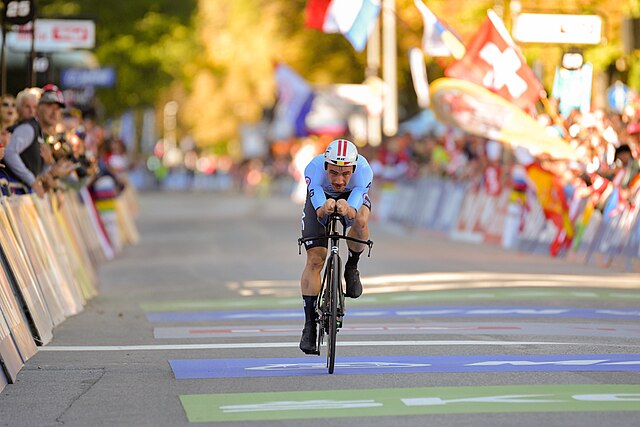
Credit: Victor Campenaerts @Granada Creative Commons Attribution-Share Alike 4.0
A classics powerhouse and an engine for the Grand Tours, Victor Campenaerts brings a unique and aggressive dimension to the team. A former UCI Hour Record holder, his immense physiological capacity is now channeled into his role as a relentless attacker and a super-domestique.
Fresh off a stage victory in the 2024 Tour de France, Campenaerts has proven he is far more than a time trial specialist. His transformation into a formidable rouleur was underscored by his victory at the 2023 Druivenkoers Overijse and earning the super-combativity award at the Tour de France in the same year. This tenacity makes him the perfect rider to infiltrate breakaways, putting pressure on rivals and creating tactical opportunities for the team leaders.
Campenaerts’ role extends to being a crucial protector on the flat and rolling terrains, capable of setting a blistering pace to deter attacks and position his teammates for the decisive moments. His experience and innovative approach to the sport make him an invaluable asset, the unpredictable and aggressive foil to the team’s more traditional climbers and classics specialists.
8. Edoardo Affini: Italian temperament collides with explosive power
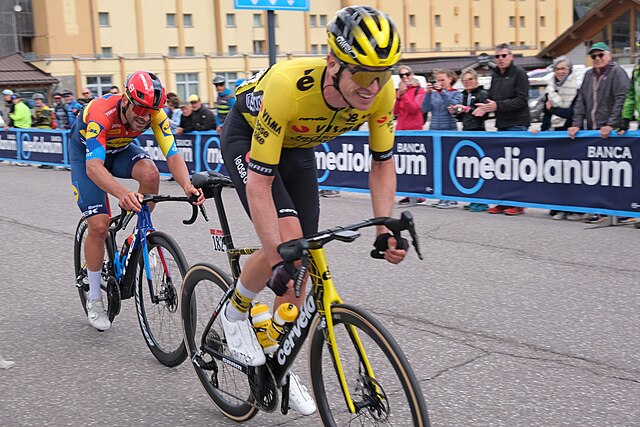
Credit: Edoardo Affini @kallerna Creative Commons Attribution-Share Alike 4.0
The powerhouse of the lead-out train, Edoardo Affini is the team’s relentless engine in the flatlands and a formidable time trialist in his own right. Standing at an imposing 1.92 meters, the Italian is the embodiment of raw power, a rider capable of holding a staggering pace in the crucial final kilometers of a race. His role is to be the ultimate protector and pilot for the team’s sprinters and GC leaders, a human shield against the wind.
Affini’s class against the clock was on full display when he became the 2024 European Time Trial Champion, a victory that underscored his individual prowess. This was further confirmed with a bronze medal at the 2024 World Championships in the same discipline. However, it is his selfless work as a “domestique” that makes him indispensable. Whether he is neutralizing attacks or delivering a textbook-perfect lead-out for a teammate, Affini is the high-torque diesel engine that propels the team towards victory.
The Enemy at the Gates: Sizing Up the Opposition
Visma’s immense strength is only relevant in the context of the rivals they face. The 2025 Tour de France is shaping up to be a battle of super-teams, a multi-polar conflict that will be more chaotic and less predictable than ever before.
The primary obstacle is, of course, Tadej Pogačar and his UAE Team Emirates squad. Pogačar is the reigning champion and arguably the strongest rider in the world, backed by a team that is a mirror image of Visma’s, featuring elite climbers like João Almeida and Adam Yates. This sets the stage for a monumental clash of two cycling titans at the peak of their powers.
The great disruptor is Remco Evenepoel of Soudal Quick-Step. The Belgian is a double Olympic champion and former Vuelta winner who finished on the Tour podium in 2024. His aggressive, unpredictable racing style means he cannot be ignored and will likely force the other contenders to react to his attacks, potentially creating openings for others.
Finally, there is the intriguing subplot of Primož Roglič. The former Visma king, who led the team before Vingegaard’s rise, now heads the ambitious Red Bull-BORA-hansgrohe squad. After abandoning the Giro d’Italia, the Tour is his sole focus. He brings an intimate knowledge of Visma’s riders, tactics, and mindset, adding a fascinating layer of internal politics and psychological warfare to the GC battle.
Final Analyses and Predicition
Team Visma | Lease a Bike enters the 2025 Tour de France as the absolute superpower and undisputed top favorite. With a roster overflowing with talent and Grand Tour experience, the sole objective is total dominance and a third consecutive overall victory for their captain. Anything less than the Yellow Jersey in Nice would be a disappointment for this armada.
Strengths:
- The Vingegaard Factor: At the center of the team is Jonas Vingegaard, the world’s best stage racer. His proven superiority in the high mountains, paired with top-tier time-trialing abilities, makes him the man to beat. The entire team and strategy are perfectly tailored to him.
- An Unparalleled Support Armada: No other team can boast such a powerful group of support riders. With Sepp Kuss (Vuelta winner), Matteo Jorgenson (Paris-Nice winner), and the blockbuster addition of Simon Yates (Vuelta winner), Vingegaard has three riders at his side who would be leaders on almost any other team. This depth allows the team to control the race on any terrain and neutralize any attack.
- Multi-Pronged Threat: Beyond the focus on the Yellow Jersey, the team possesses the ultimate all-rounder in Wout van Aert. Van Aert can win sprints, hilly stages, and time trials, all while serving as a crucial domestique. The presence of Simon Yates as a potential co-leader or super-domestique forces rivals to mark multiple riders, which can create tactical openings for Vingegaard.
- The Engine Room for the Flats: With specialists like Edoardo Affini and Victor Campenaerts, the team has the necessary horsepower to control the peloton on the flat stages, pull back breakaways, and position their captain safely and efficiently at the foot of the key climbs.
Weaknesses/Challenges:
- The Weight of Expectation: The team will have to carry the burden of the race every single day. All eyes will be on them to control breakaways and set the pace. This constant pressure can be draining over three weeks and leaves no room for error.
- Predictability: Their strategy is clear: lead Vingegaard to victory. While their strength often makes this unstoppable, their rivals know exactly what to expect. The challenge for other teams isn’t guessing what Visma will do, but rather finding a weakness in their seemingly impenetrable armor.
Prediction:
- Yellow Jersey: The primary objective and the highest probability. Jonas Vingegaard is the overwhelming favorite for the overall victory. If he stays crash- and illness-free, it is difficult to see who can beat him over three weeks. In Jorgenson and Yates, the team also has luxurious backup options who could still finish in the Top 10 even while in a support role.
- Green Jersey: A strong secondary objective, but a complicated one. Wout van Aert has the skillset to win the points classification. However, it will heavily depend on how much freedom he is granted. Will he have to stay with Vingegaard instead of contesting intermediate sprints? The decision between the yellow and green jersey objectives will be a daily strategic balancing act.
- Stage Wins: Extremely likely. This team can win on almost any stage. Vingegaard in the mountains; Van Aert in sprints, on hilly stages, and in time trials. Kuss, Jorgenson, or Yates could succeed from a late attack or a breakaway if given the tactical freedom. A realistic prediction is 4-5 stage wins.
For Team Visma | Lease a Bike, the 2025 Tour de France will be a demonstration of force. Success will be measured solely by the Yellow Jersey on the podium in Nice, with multiple stage wins and potentially other jerseys expected as an impressive bonus.
 The Daily Ride


.jpg)


Leave a comment